0
Crest Gates Open

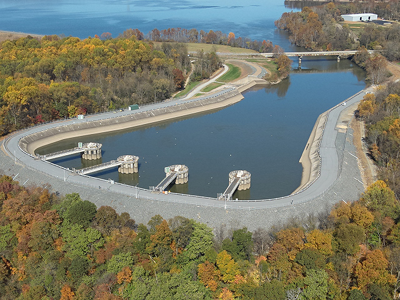
The Conowingo Dam was an engineering marvel when constructed nearly a century ago, and it continues to operate safely and reliably today. Located on the lower Susquehanna River in northern Maryland, Conowingo has served as Maryland's largest source of renewable energy since it began operation in 1928. Owned and operated by Constellation, the Conowingo Dam currently has 11 turbines, which can produce up to 572 megawatts (MW) of electricity. Over the years, the Conowingo Dam has played an important role in protecting the Chesapeake Bay, supporting local and state economies, and providing recreational opportunities for thousands of local residents and tourists.
The dam also has a visitors center where the public can learn about the history of Conowingo, the role of hydroelectricity as a renewable energy source, and about nearby recreational facilities and public access areas available for residents and tourists. These recreational activities include birdwatching, picnics, photography and more. Constellation maintains several public parks as part of its Conowingo license and welcomes thousands of visitors eager to learn about local ecology every year.

Hyrdoelectric
2569 Shures Landing Road, Darlington, Maryland 21034
Get Directions
On Oct. 2, 2025, Governor Wes Moore announced a historic agreement with Constellation to fund operational and environmental projects at the Conowingo Dam valued at more than $340 million and negotiated in partnership with Waterkeepers Chesapeake and Lower Susquehanna Riverkeeper Association. The agreement clears the way for the re-licensing and continued operation of the dam for an additional 50 years.
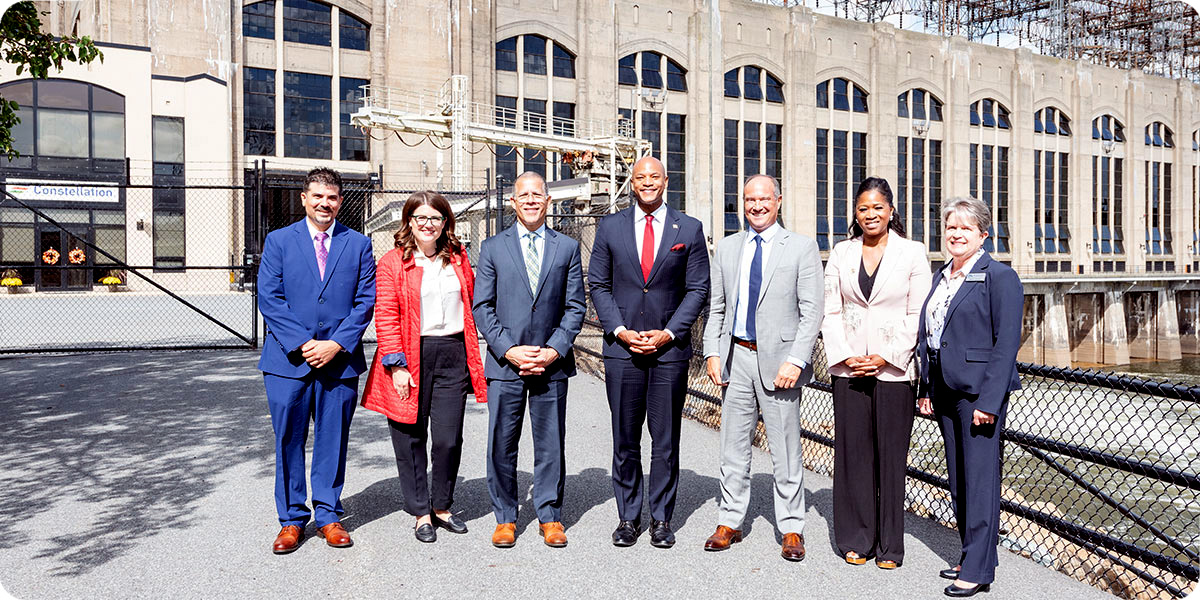 (Left to right) Ted Evgeniadis, Executive Director, Lower Susquehanna Riverkeeper; Maryland Congresswoman Sarah Elfreth, 3rd District; Maryland Attorney General Anthony Brown; Maryland Governor Wes Moore; CEO Joe Dominguez; Maryland Secretary of the Environment Serena McIlwain; and Robin Broder, Acting Executive Director, Waterkeepers Chesapeake
Constellation received a 50-year license from the Federal Energy Regulatory Commission (FERC) on March 19, 2021 to continue operating the Conowingo Dam. The license is a critical step forward for Chesapeake Bay restoration efforts and paves the way for long-term investments that will enhance water quality, fish and eel passage, aquatic habitats and debris removal. It also enables the continued operation of Maryland’s largest source of renewable energy, which generates safe, reliable power for tens of thousands of families and businesses in the state.
To comply with Federal Energy Regulatory Commission (FERC) requirements, we open the dam's crest gates when river conditions require. We are committed to continually informing and working with community and government partners to fulfill our shared responsibility to protect and restore the health of the bay.
In addition to powering homes and businesses, the Conowingo Dam produces economic and environmental benefits for both the state and local communities throughout the region.
In October 2019, the State of Maryland and Constellation reached a historic agreement that will help protect the Chesapeake Bay for decades to come. Read more about the full agreement.
As a part of Maryland’s vital energy infrastructure, the Conowingo Dam provides $273 million in economic benefits every year, which includes supporting 265 full-time equivalent jobs, paying $10 million in annual state and local taxes, and attracting 365,000 recreational visits annually. As a major tourist site in eastern Maryland, the Conowingo Dam and recreation area contribute to Cecil and Harford Counties’ $21.7 million in tax revenue from tourism in 2018. The Conowingo Pond, located behind the dam, is vital to the water supply for several communities, serving as a back-up water supply source for both the City of Baltimore and the Chester Water Authority.
With more than a dozen community events every year, Constellation is proud to be involved with several charitable activities and non-profit organizations committed to Maryland and the Chesapeake Bay. Our employees proudly participate in a variety of charitable activities, such as donations to the local United Way chapters, the Boys and Girls Clubs of Cecil and Harford Counties, the Harford Family House, the Stroud Water Research Center, and the Plumpton Park Zoological Gardens, Inc., among others.
We share the State of Maryland’s commitment to restoring and sustaining the health of the Chesapeake Bay. That's why in October 2019, the State of Maryland and Constellation reached a historic agreement that will help protect the Chesapeake Bay for decades to come. The benefits to Maryland and the Chesapeake Bay are valued at more than $200 million over the anticipated 50-year life of the license, which will be funded from the dam’s earnings over that time period. These funds will be used to address key issues facing the bay, including upstream debris, fish and eel passage, nutrient reduction, mussel restoration, and resiliency initiatives.
Read more about the full agreement and all of the benefits for the Chesapeake Bay.
One of the key environmental issues for the Chesapeake Bay is debris. Debris originates upstream from the more than 27,500 miles of tributaries and streams in the Susquehanna River watershed, flowing down through New York, Pennsylvania, and Maryland. Our agreement with the U.S. Department of Interior also includes significant investments in fish passage improvements at the dam and the creation or re-introduction of a trap-and-transport program to transport fish from Conowingo Dam to north of the York Haven Dam. In addition, Constellation will fund a total of $11 million for improvements to eel passage and to benefit nutrient reductions and aquatic habitats, plus $1 million to fund eel passage research.
To comply with Federal Energy Regulatory Commission (FERC) requirements, we open the Conowingo Dam's crest gates when river conditions require. We are committed to continually informing and working with community and government partners to fulfill our shared responsibility to protect and restore the health of the bay.
Constellation uses a variety of tools and resources to help remove the debris safely and efficiently, including:
Through these efforts, we removed more than 4,000 tons of debris in 2018 alone. Although Constellation voluntarily removes debris from the river, it is not possible to remove all debris flowing toward the dam from the upstream watershed. This is especially true during flood conditions, as seen during the summer of 2018 when the Susquehanna River swelled to 10 times its normal level.
The Conowingo Dam continues to play an instrumental role in wildlife conservation. In the early 1990s, a $12 million fish lift was completed at the dam, which has restored more than 1 million American shad, returning them to the upper Susquehanna River and supporting local recreational fishing. Moreover, 300 American bald eagles gather at the Conowingo Dam annually by Thanksgiving, which they use as a major breeding, nesting, and foraging ground.
Constructed in 1928, the Conowingo Dam originally produced 252 megawatts (MW) of power, becoming the second-largest hydroelectric project in the United States after Niagara Falls. Today, the dam includes 11 turbines and can generate up to 572 MW of pollution-free electricity, powering 165,000 homes, on average. In fact, the dam's renewable energy production is greater than all other Maryland renewable energy sources combined.
The dam is also a critical player in meeting the state's renewable energy and climate action goals and prevents 867,000 metric tons of greenhouse gas emissions each year, the equivalent of taking 186,000 cars off the road.


To comply with Federal Energy Regulatory Commission (FERC) requirements, we open the dam's crest gates when river conditions require.
No, the Conowingo Dam does not produce any pollution.
Debris originates upstream from the more than 27,500 miles of tributaries and streams in the Susquehanna River watershed, which flows across New York, Pennsylvania and Maryland.
In October 2019, the State of Maryland and Constellation reached a historic agreement that will help protect the Chesapeake Bay for decades to come.
In keeping with our strong track record of environmental stewardship, we will contribute more than $200 million from the Conowingo Dam’s operation over the next 50 years to address key issues facing the bay, including upstream debris, fish and eel passage, nutrient reduction, mussel restoration and resiliency initiatives. Specifically, the $200 million in contributions to restore and sustain the Chesapeake Bay include the following initiatives:
Restoration and Protection of the Chesapeake Bay
Enhanced Debris Management
Continued commitments valued at $41 million to address debris accumulation, including an engineering study examining additional methods to divert debris before it reaches the dam, and employment of clamming, skimming, or other equally effective means of debris removal.
Enhanced Habitat and Fish Passage Improvements
Read more about the full terms of the agreement.
Locations